

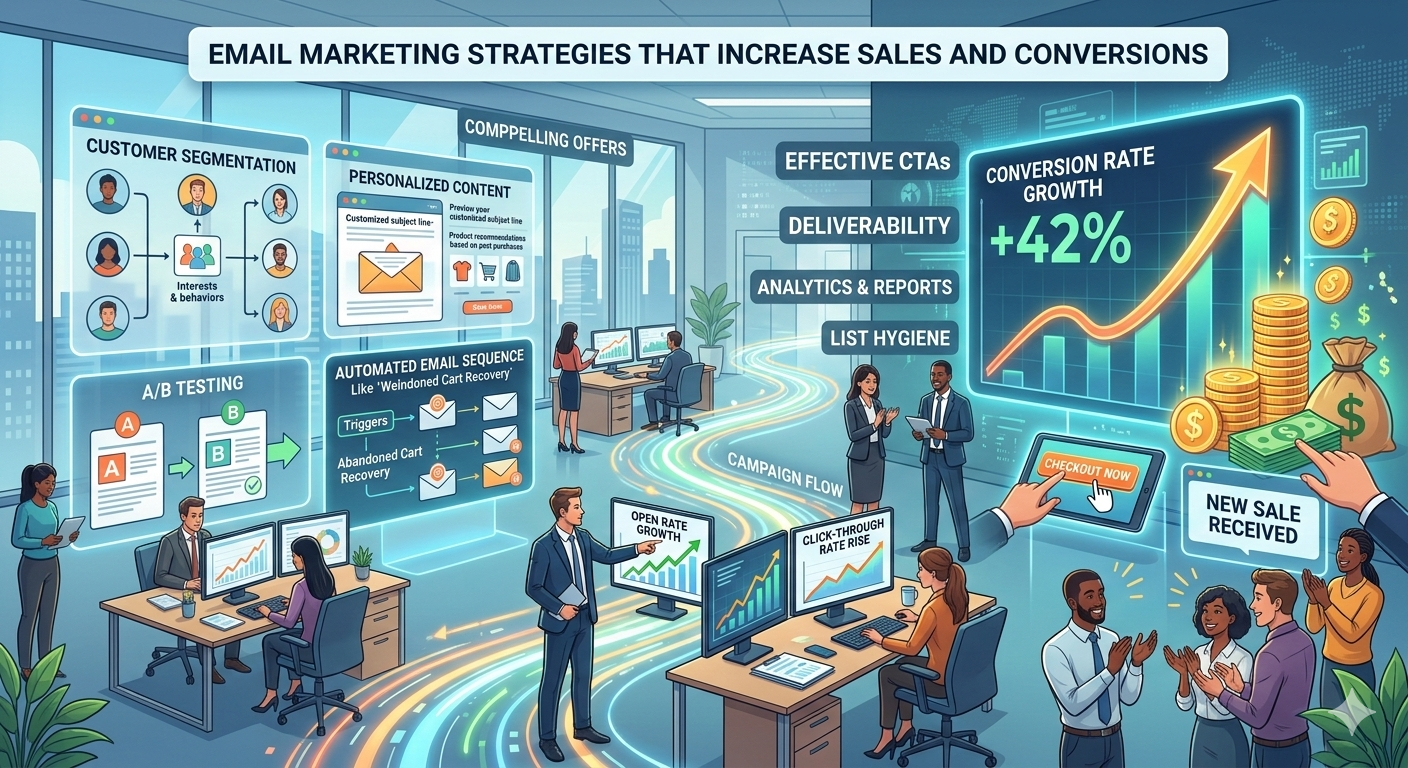

Email marketing remains one of the most effective tools for driving sales, nurturing customer relationships, and boosting conversions. While social media and other digital channels have grown rapidly, email continues to offer a direct, personalized, and measurable way to reach customers. For businesses seeking to improve ROI and generate sales, implementing the right strategies is crucial. In this article, we explore actionable email marketing strategies that increase sales and conversions.
1. Understanding the Power of Email Marketing
Before diving into strategies, it’s essential to understand why email marketing is so effective. According to multiple studies, email marketing provides an average ROI of $42 for every $1 spent. This high return is largely because email allows businesses to communicate directly with their audience, personalize messages based on customer preferences, track engagement with measurable analytics, and automate campaigns to nurture leads over time. Unlike social media, where algorithms limit organic reach, emails land directly in the inbox of your subscribers. This direct access creates opportunities for higher engagement and increased sales.
2. Building a Quality Email List
The foundation of any successful email marketing campaign is a high-quality, permission-based email list. Your strategies to increase sales and conversions depend heavily on reaching the right audience. Here’s how to build and maintain a strong email list:
a) Use Opt-In Forms Strategically
Place opt-in forms on high-traffic areas of your website, such as landing pages, blog posts, pop-ups, and checkout pages. Encourage sign-ups by offering value, such as free eBooks or guides, exclusive discounts or promotions, or access to webinars or tutorials.
b) Segment Your Audience
Not all subscribers are the same. Segment your list based on demographics, purchase history, engagement levels, or interests. For instance, new subscribers may receive a welcome series, while returning customers may receive product recommendations or loyalty offers.
c) Maintain List Hygiene
Regularly clean your list to remove inactive subscribers or invalid emails. This improves deliverability rates and ensures your campaigns target engaged, interested prospects.
3. Crafting High-Converting Email Content
Once you have a quality list, the next step is to create emails that drive engagement and conversions. Here are strategies for crafting compelling content:
a) Write Engaging Subject Lines
The subject line is the first thing your recipients see, and it often determines whether the email is opened. Use subject lines that are clear and concise, personalized, actionable or curiosity-driven, and relevant to the offer inside. For example: “John, Unlock 20% Off Your Next Purchase Today!”
b) Personalize the Content
Personalization goes beyond using the recipient’s name. Tailor content based on previous purchases, browsing behavior, or engagement patterns. Personalized recommendations can significantly increase click-through rates and conversions.
c) Use Compelling Calls-to-Action (CTAs)
Every email should have a clear, compelling CTA. Use action-oriented words like “Shop Now,” “Claim Your Discount,” or “Start Your Free Trial.” Ensure that the CTA stands out visually and is easy to click, even on mobile devices.
d) Focus on Value, Not Just Sales
While the goal is to drive conversions, overly promotional emails can alienate subscribers. Focus on providing value through educational content, helpful tips or guides, exclusive offers, and social proof or testimonials. When subscribers see consistent value, they are more likely to trust your brand and make purchases.
4. Automating Email Campaigns
Automation allows businesses to nurture leads and guide them through the sales funnel without constant manual effort. Automated campaigns are highly effective for increasing sales and conversions. Here’s how to leverage them:
a) Welcome Series
A welcome email series introduces new subscribers to your brand, sets expectations, and often includes a special offer. For example, Email 1: Welcome message and brand story, Email 2: Top products or services, Email 3: Exclusive discount or incentive. Welcome series emails typically have higher open and click-through rates than regular campaigns, making them ideal for conversions.
b) Abandoned Cart Emails
Abandoned cart emails target users who added products to their cart but didn’t complete the purchase. These emails can recover lost sales by reminding the customer of their items and offering incentives like discounts or free shipping.
c) Post-Purchase Follow-Ups
Post-purchase emails strengthen relationships and encourage repeat purchases. Examples include thank-you emails, product usage tips, requests for reviews or referrals, and recommendations for complementary products.
d) Re-Engagement Campaigns
Re-engagement campaigns target inactive subscribers to rekindle interest. Offer value such as exclusive discounts or curated content to bring them back.
5. Using Segmentation for Higher Conversions
Segmentation is one of the most powerful strategies to increase email marketing effectiveness. Instead of sending generic emails, segment your list based on behavior, preferences, or demographics. Benefits of segmentation include improved open and click-through rates, increased relevancy of offers, reduced unsubscribes, and higher conversions. Examples of segmentation strategies: Purchase Behavior: Target customers based on past purchases or product categories. Engagement Level: Send reactivation campaigns to dormant subscribers. Demographics: Tailor content based on age, location, or interests. Lifecycle Stage: Provide different offers for new, returning, and loyal customers.
6. Optimizing for Mobile Devices
With more than 60% of emails opened on mobile devices, mobile optimization is critical. Ensure your emails are responsive to different screen sizes, easy to read with concise copy, designed with large, tappable buttons for CTAs, and loaded quickly, even with images. Neglecting mobile users can lead to lost opportunities and lower conversions.
7. A/B Testing to Maximize Results
A/B testing, also known as split testing, is crucial for identifying what works best for your audience. Test elements such as subject lines, email copy and tone, CTA placement and wording, design and layout, and images vs. no images. By analyzing results and making data-driven adjustments, you can continuously improve open rates, click-through rates, and conversions.
8. Leveraging Social Proof and Urgency
Humans are influenced by the behavior and opinions of others. Using social proof and urgency in emails can drive conversions:
a) Social Proof
Include testimonials, reviews, user-generated content, or case studies to build trust and credibility. Example: “Over 10,000 customers have transformed their workflow with our tool.”
b) Scarcity and Urgency
Limited-time offers, low-stock alerts, or countdown timers create urgency, motivating subscribers to act quickly. Example: “Hurry! Only 3 items left at this price – offer ends tonight!”
9. Integrating Email with Other Marketing Channels
Email marketing works best when integrated with other marketing strategies. Consider retargeting ads to follow email recipients with personalized ads on social media or Google, promote blog posts or guides via email to nurture leads, complement email campaigns with SMS alerts for time-sensitive offers, and encourage subscribers to follow or share content on social platforms. Integrating channels provides a cohesive experience and reinforces messaging, increasing conversion potential.
10. Monitoring Analytics and KPIs
To improve sales and conversions, track and analyze key performance indicators (KPIs) such as open rate, click-through rate (CTR), conversion rate, bounce rate, and unsubscribe rate. Use these insights to refine strategies, test new approaches, and optimize campaigns over time.
11. Advanced Personalization and AI
Advanced email marketing techniques use AI and data analytics to further increase conversions: Predictive Recommendations: Suggest products based on past behavior or similar users. Dynamic Content: Automatically tailor sections of emails to each recipient. Send Time Optimization: AI determines the best time to send emails for maximum engagement. Leveraging AI ensures that every email is as relevant and timely as possible, which increases sales opportunities.
12. Compliance and Trust
Finally, compliance with email regulations such as CAN-SPAM, GDPR, or other local laws builds trust and ensures your campaigns reach recipients legally. Key compliance practices include obtaining explicit consent from subscribers, providing easy unsubscribe options, including your business’s physical address, and being transparent about how data is used. A trustworthy email strategy encourages subscribers to engage and purchase confidently.
Conclusion
Email marketing remains one of the most effective strategies for increasing sales and conversions. Success lies in combining several key tactics: building a high-quality email list, segmenting audiences for relevant targeting, crafting engaging, personalized content, using automation to nurture leads, testing and optimizing campaigns, leveraging social proof and urgency, and monitoring analytics while integrating with other channels. By implementing these strategies, businesses can transform their email campaigns from generic communication tools into powerful sales-generating machines. The ultimate goal is to provide value, build trust, and guide subscribers toward making informed purchasing decisions. Whether you are a beginner or an experienced marketer, a thoughtful and strategic approach to email marketing can significantly boost conversions, increase customer loyalty, and drive long-term revenue growth.
